
Introduction
The interior design industry is undergoing a major transformation driven by digital tools, client expectations, and faster project delivery demands. Today’s clients want more than aesthetic spaces—they expect accuracy, real-time visualization, cost transparency, and faster approvals. Traditional interior design workflows often rely on 2D drawings, manual coordination, and physical samples, which can slow down decision-making and create gaps between design intent and execution. To solve these challenges, professionals are increasingly adopting Building Information Modeling (BIM). One of the most valuable learning paths in this shift is BIM for interior design professionals, which helps designers merge creativity with technical precision and data-driven decision-making.
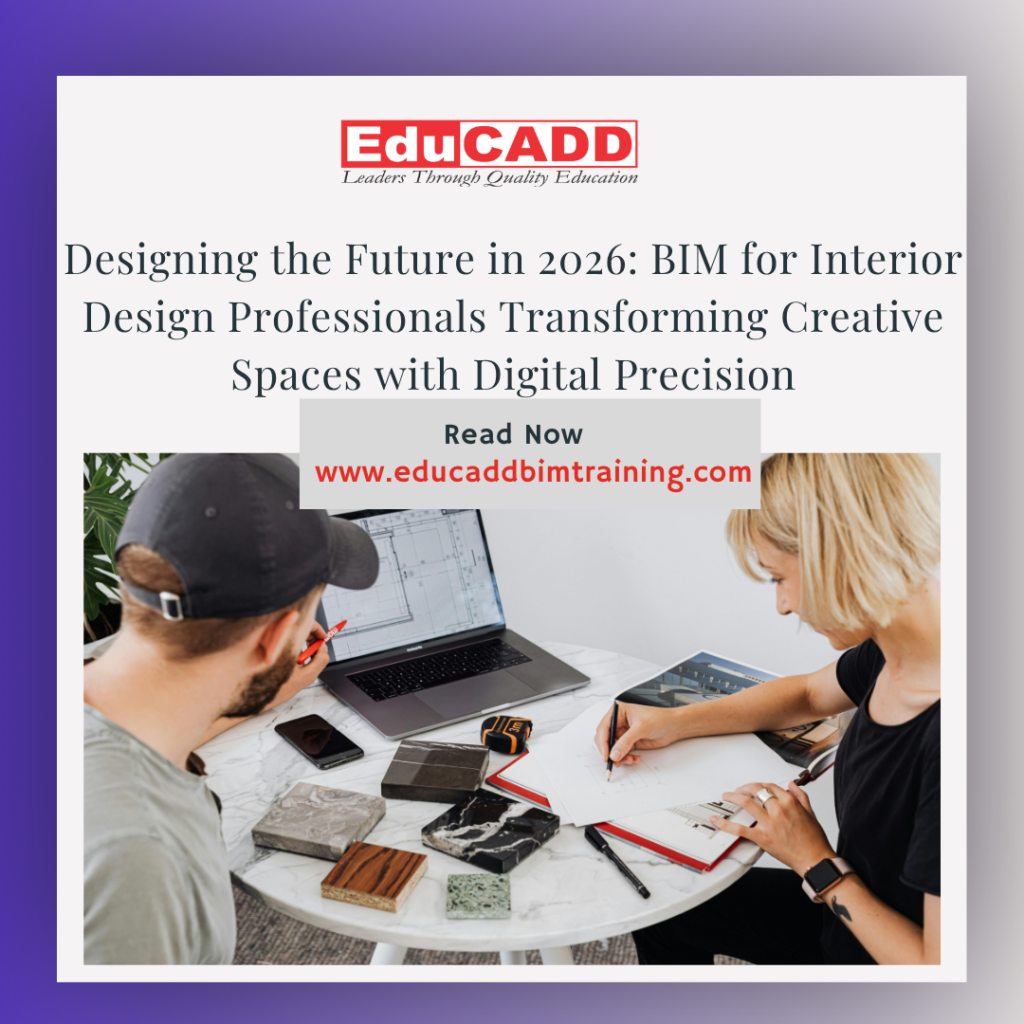
BIM enables interior designers to build intelligent 3D environments where every element—walls, furniture, lighting, materials, and finishes—is connected with real data. This improves coordination, reduces errors, and enhances visualization quality. Industry-standard tools like Autodesk Revit and SketchUp allow designers to create immersive, accurate, and editable interior models. This expanded guide explains BIM in interior design in greater depth with practical applications and real-world relevance.
1. Understanding BIM in Interior Design
BIM in interior design is a digital process that integrates spatial design, material data, lighting, and furniture layouts into a single intelligent model. Unlike traditional drafting, BIM connects design elements with information that can be analyzed and updated in real time.
Designers can explore spatial arrangements, material combinations, and lighting conditions before construction begins, reducing uncertainty.
The BIM for interior design professionals approach helps designers transition from static drawings to dynamic, data-rich design environments.
It also improves coordination with architects and engineers by ensuring that all disciplines work on a unified model.
Furthermore, BIM allows designers to track design changes efficiently, ensuring consistency across all project stages.
2. Importance of Interior Design in Modern Spaces
Interior design today is not just about aesthetics; it directly impacts functionality, user experience, and psychological comfort.
Well-designed interiors improve productivity in offices, relaxation in homes, and customer engagement in commercial spaces.
It also plays a key role in maximizing space utilization, especially in urban environments where space is limited.
Modern clients also demand sustainable, flexible, and technology-integrated interior solutions.
Additionally, interior design contributes to brand identity in commercial projects and lifestyle expression in residential projects.
3. Role of BIM in Interior Visualization
BIM enhances interior visualization by offering realistic 3D models that simulate real-world environments. Designers can preview textures, lighting, shadows, and spatial arrangements accurately.
This helps clients understand design intent clearly before execution begins.
Additionally:
- Improve client communication through interactive 3D walkthroughs
- Reduce redesign cycles by identifying issues early
BIM also allows designers to present multiple design options quickly, making decision-making easier for clients.
This improves approval rates and reduces delays in project execution.
4. Material Selection and Accuracy
Material selection is a critical part of interior design, and BIM makes this process more data-driven and precise.
Designers can assign real-world material properties such as texture, reflectivity, and durability directly within the model.
This helps evaluate how materials will behave under different lighting and usage conditions.
It also reduces costly mistakes caused by incorrect material selection during execution.
Moreover, BIM enables comparison between multiple material options based on cost, sustainability, and aesthetics.
5. Space Planning and Optimization
Space planning is one of the most important aspects of interior design. BIM helps designers analyze spatial layouts with high precision.
Designers can test different furniture arrangements and circulation paths digitally before implementation.
This ensures optimal use of available space.
Better planning improves functionality, comfort, and accessibility within the space.
It also helps in complying with safety regulations and ergonomic standards.
6. Lighting Design and Simulation
Lighting design plays a major role in setting the mood and functionality of interior spaces. BIM allows designers to simulate both natural and artificial lighting conditions.
They can study how sunlight enters a space at different times of the day.
For example:
- Optimize daylight in living rooms for energy savings
- Design focused lighting for workspaces to improve productivity
BIM also helps evaluate energy consumption of lighting systems.
This leads to more sustainable and cost-efficient interior designs.
7. Improved Collaboration with Stakeholders
Interior design projects involve multiple stakeholders, including architects, contractors, engineers, and clients.
BIM creates a shared digital platform where everyone can access the same updated design model.
This reduces miscommunication and ensures design consistency across teams.
It also allows real-time feedback, which improves decision-making speed.
Better collaboration leads to smoother project execution and fewer conflicts on-site.
8. Cost Estimation in Interior Design
BIM enables accurate cost estimation by linking every design element with material and pricing data.
Designers can calculate costs in real time as the design evolves.
This helps clients understand budget implications early in the design phase.
It also reduces the risk of unexpected expenses during execution.
Accurate cost planning improves financial control and client trust.
9. Integration with Design Software
Modern interior designers rely on advanced software tools for modeling, visualization, and documentation.
Autodesk Revit is widely used for detailed BIM modeling and documentation.
SketchUp is popular for conceptual design and quick visualization.
When integrated, these tools improve workflow efficiency and allow seamless transitions between concept and execution.
This integration also reduces duplication of work and improves design accuracy.
10. Furniture Layout and Customization
BIM allows designers to create highly customized furniture layouts based on client needs and spatial constraints.
Each furniture element can be edited, resized, and repositioned easily within the model.
This helps test multiple layout options quickly.
It also ensures that furniture fits perfectly within the available space.
Customization improves both functionality and aesthetic appeal.
11. Sustainable Interior Design Practices
Sustainability is becoming a major focus in interior design. BIM helps designers choose eco-friendly materials and optimize energy usage.
It supports analysis of carbon footprint and material lifecycle.
Designers can also simulate energy-efficient lighting and ventilation systems.
Sustainable design reduces environmental impact and improves long-term cost efficiency.
Clients increasingly prefer environmentally responsible interior solutions.
12. Client Presentation and Approval Process
BIM improves client presentations by offering immersive 3D walkthroughs and realistic visualizations.
Clients can explore spaces virtually before construction begins.
This builds confidence and reduces misunderstandings.
It also speeds up approval cycles, as clients can clearly see design outcomes.
Fewer revisions are needed, which saves time and effort.
13. Career Opportunities in BIM Interior Design
The demand for BIM-skilled interior designers is increasing across architecture firms, design studios, and real estate companies.
Professionals trained in BIM for interior design professionals are preferred for high-end residential, commercial, and hospitality projects.
This skill also opens opportunities in international design markets.
It enhances career growth, salary potential, and job stability.
BIM expertise is becoming a standard requirement in modern interior design careers.
14. Future Scope of BIM in Interior Design
The future of interior design will be driven by AI, VR, AR, and real-time collaboration technologies.
Designers will create immersive environments where clients can experience spaces before construction.
Automation will further simplify repetitive design tasks.
This makes BIM for interior design professionals a future-ready skill.
It will redefine how interior spaces are designed, visualized, and executed globally.
Conclusion
Interior design is evolving into a highly technical and digital profession. Creativity alone is no longer enough—precision, data, and collaboration are equally important. BIM is bridging the gap between design imagination and real-world execution.
Understanding BIM for interior design professionals is essential for anyone aiming to succeed in today’s competitive design industry. It improves visualization, enhances accuracy, and strengthens coordination between all stakeholders.
As the construction and design sector continues to grow in India, professionals who master BIM for interior design professionals will lead the future of intelligent, sustainable, and highly efficient interior spaces.