
Introduction
The construction industry in India is moving toward highly digital and model-based engineering workflows. Infrastructure projects are becoming larger, more complex, and more time-sensitive than ever before. In this environment, structural steel plays a central role in delivering strong, durable, and fast-built structures such as industrial plants, stadiums, high-rise towers, bridges, and warehouses. However, traditional steel detailing methods based on 2D drawings often struggle to meet modern accuracy and speed requirements. These methods depend heavily on manual coordination, which increases the risk of errors, clashes, and fabrication delays. To solve these challenges, the construction industry is increasingly adopting Building Information Modeling (BIM). One of the most powerful applications in this domain is BIM for structural steel detailing, which improves precision, coordination, and fabrication efficiency across the entire project lifecycle.
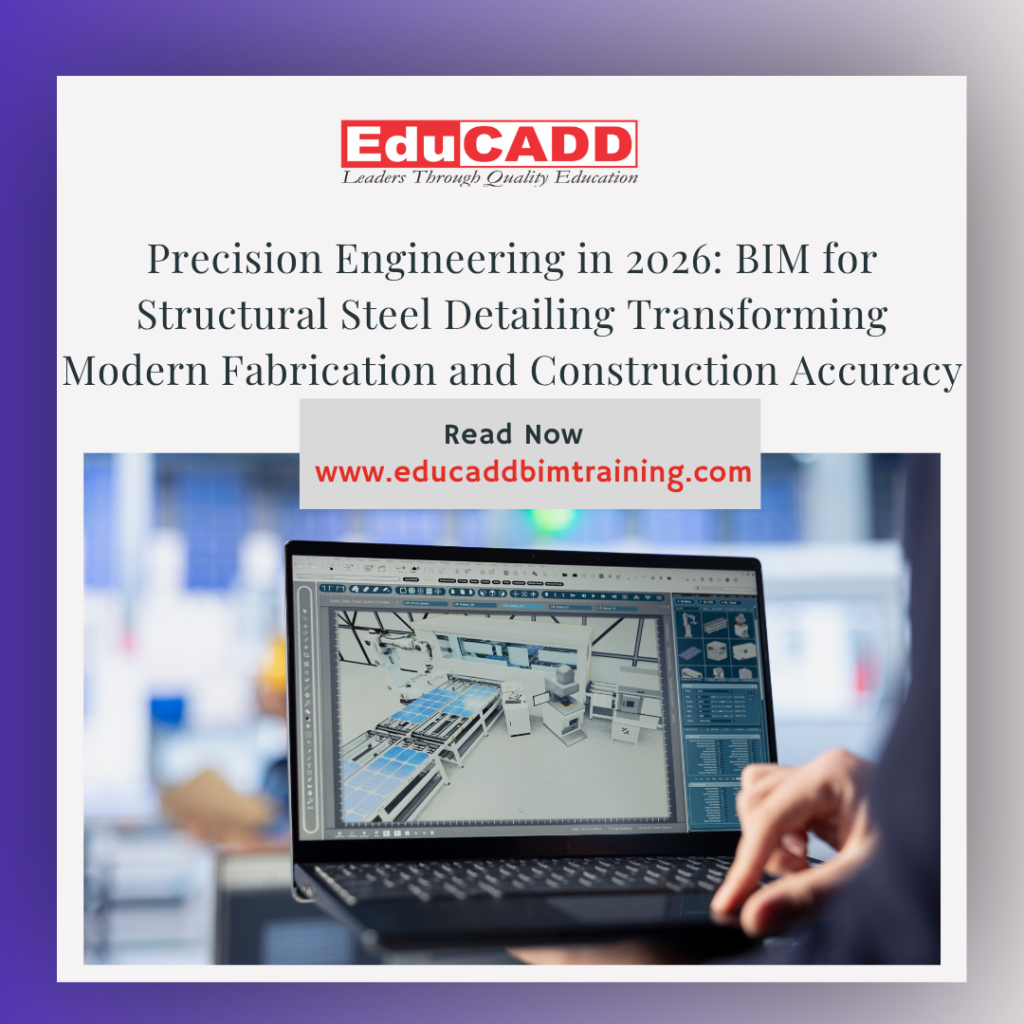
BIM creates a data-rich 3D environment where every steel element is digitally represented with full technical information. This includes geometry, connections, welding details, material specifications, and fabrication data. Engineers and detailers can now connect design directly with manufacturing processes. Industry tools like Tekla Structures and Autodesk Revit allow seamless modeling, coordination, and output generation. This expanded guide explores BIM in steel detailing in much greater depth with real-world relevance.
1. Understanding BIM in Structural Steel Detailing
BIM in structural steel detailing refers to the process of creating intelligent 3D models that represent every steel component of a structure with complete technical and fabrication data. These models go beyond visualization and act as digital construction prototypes.
Each beam, column, plate, bolt, and weld is embedded with metadata that can be used for fabrication and installation. This eliminates ambiguity in design interpretation.
The BIM for structural steel detailing approach ensures that engineers, detailers, and fabricators work from a single coordinated model, reducing communication gaps.
It also supports continuous updates, meaning any design change is automatically reflected across all drawings and schedules.
Additionally, BIM helps standardize detailing practices across teams working in different locations, improving consistency and quality.
2. Importance of Structural Steel Detailing in Construction
Structural steel detailing is a critical stage in construction because it defines how steel structures are fabricated and assembled on-site. It directly impacts structural strength and stability.
Accurate detailing ensures that steel members fit perfectly during installation, reducing rework and delays.
Poor detailing can lead to misalignment, structural issues, and increased project costs.
It also plays a key role in ensuring compliance with engineering codes and safety standards.
In large infrastructure projects, precise detailing becomes essential for maintaining structural integrity under heavy loads and environmental conditions.
3. Role of BIM in Steel Fabrication Accuracy
BIM significantly improves fabrication accuracy by providing highly detailed and error-free 3D models that directly guide manufacturing processes.
Fabricators can extract exact measurements, cutting lists, and assembly instructions from the BIM model.
Additionally:
- Reduce human interpretation errors during fabrication
- Improve consistency in mass production of steel components
This leads to faster fabrication cycles and fewer rejected components.
BIM also helps align fabrication with installation sequences, ensuring smooth on-site assembly.
4. 3D Modeling for Steel Structures
3D modeling is the foundation of BIM-based steel detailing. It allows engineers to build complete structural systems digitally before physical construction begins.
Every steel member is modeled with real-world accuracy, including dimensions, connection types, and load behavior.
This helps engineers visualize how the structure will perform under different conditions.
It also allows early detection of design flaws or structural inefficiencies.
Advanced modeling improves collaboration between architects and structural engineers, ensuring better design integration.
5. Clash Detection in Steel Detailing
Clash detection is one of the most valuable features of BIM in structural steel projects. It identifies conflicts between steel elements and other building systems such as MEP and architecture.
Early detection prevents costly rework during construction.
Tools like Tekla Structures automatically highlight clashes within the model.
Additionally:
- Avoid structural interference with ducting and piping systems
- Improve coordination between multiple engineering disciplines
This ensures smoother project execution and reduces delays caused by on-site modifications.
6. Improved Coordination Between Teams
BIM creates a centralized platform where structural engineers, fabricators, contractors, and project managers collaborate in real time.
All stakeholders access the same updated model, reducing confusion caused by outdated drawings.
This improves transparency and accountability in project execution.
It also allows faster approval cycles for design changes.
Better coordination leads to improved productivity and fewer construction disputes.
7. Automated Shop Drawings
BIM automates the creation of shop drawings, which are essential for steel fabrication and assembly.
These drawings include precise dimensions, connection details, bolt specifications, and welding instructions.
Automation reduces manual drafting time significantly.
It also ensures consistency between design intent and fabrication output.
Errors caused by manual interpretation are greatly reduced, improving overall construction quality.
8. Material Optimization and Cost Efficiency
BIM enables precise quantity takeoff for steel materials, helping optimize procurement and reduce wastage.
Engineers can calculate exact steel requirements before fabrication begins.
This allows better planning of raw material usage and supply chain management.
For example:
- Optimize steel cutting patterns to minimize scrap loss
- Improve ordering accuracy based on real-time model data
This leads to significant cost savings and more sustainable construction practices.
9. Integration with Advanced BIM Tools
Modern steel detailing depends heavily on advanced BIM platforms that support modeling, coordination, and documentation.
Autodesk Revit is widely used for structural modeling and interdisciplinary coordination.
Tekla Structures is preferred for fabrication-level detailing and shop drawing generation.
Integration between these tools ensures smooth data transfer from design to fabrication.
It also reduces duplication of work and improves workflow efficiency across project teams.
10. Construction Sequencing and Planning
BIM allows engineers to simulate construction sequences for steel structures before actual execution.
This helps plan installation order, crane positioning, and assembly workflows.
It reduces on-site confusion and improves construction speed.
Sequencing simulations also help identify potential logistical challenges early.
Better planning ensures safer and more efficient construction operations.
11. Safety Improvements in Steel Construction
Safety is a critical aspect of steel construction due to heavy lifting and high-altitude work.
BIM helps simulate construction activities to identify safety risks in advance.
Engineers can analyze lifting paths, temporary supports, and assembly risks.
Additionally:
- Reduce accidents during steel erection processes
- Improve compliance with safety regulations and standards
This creates a safer working environment for construction teams.
12. Quality Control in Fabrication
BIM improves quality control by ensuring that every steel component matches the design specifications exactly.
Fabricators can verify dimensions and connections before production.
This reduces errors during manufacturing and installation.
It also ensures compliance with international engineering standards.
Higher quality control leads to stronger and more reliable structures.
13. Career Opportunities in BIM Steel Detailing
The demand for skilled BIM steel detailers is growing rapidly in construction, infrastructure, and fabrication industries.
Professionals trained in BIM for structural steel detailing are highly valued for their technical and software expertise.
They can work in structural design firms, EPC companies, and fabrication workshops.
This field offers strong salary growth and international job opportunities.
As BIM adoption increases, career prospects will continue to expand.
14. Future Scope of BIM in Steel Detailing
The future of steel detailing is moving toward full automation, AI integration, and digital fabrication.
BIM will integrate with robotics and advanced manufacturing systems for faster production.
Design-to-fabrication workflows will become fully digital and highly efficient.
This makes BIM for structural steel detailing an essential skill for future engineers.
It will redefine global standards for precision engineering and construction efficiency.
Conclusion
Structural steel detailing is evolving into a highly precise and technology-driven discipline. BIM is playing a transformative role by improving accuracy, coordination, and fabrication efficiency across all stages of construction.
Understanding BIM for structural steel detailing is essential for engineers, detailers, and fabricators who want to succeed in modern construction environments. It reduces errors, improves productivity, and ensures better project outcomes.
As infrastructure development continues to expand in India, professionals who master BIM for structural steel detailing will lead the future of intelligent, efficient, and high-precision construction systems.