
Introduction
The construction industry is experiencing a powerful shift toward digital technologies, and Building Information Modeling (BIM) is leading this transformation. As companies adopt smarter and more efficient workflows, the demand for skilled BIM professionals continues to grow. Many students and professionals are now exploring BIM job roles and responsibilities training to build a successful and future-ready career. Understanding these roles and responsibilities is essential for anyone who wants to enter or grow in the BIM field.
BIM is not just about software; it involves coordination, data management, and collaboration across multiple teams. Proper training helps individuals understand how projects are planned, executed, and managed using BIM processes. In this blog, we will explore in detail BIM job roles and responsibilities training, giving you a clear roadmap to succeed in this dynamic industry.
1. Understanding BIM and Its Importance
Before learning about roles and responsibilities, it is important to understand what BIM is and why it matters. BIM is a digital process that creates intelligent 3D models containing both design and data. These models help improve project efficiency and reduce errors.
BIM enhances collaboration between architects, engineers, and contractors. This integrated approach makes construction projects more efficient and cost-effective. Understanding this foundation is the first step in BIM job roles and responsibilities training.
2. Overview of BIM Job Roles
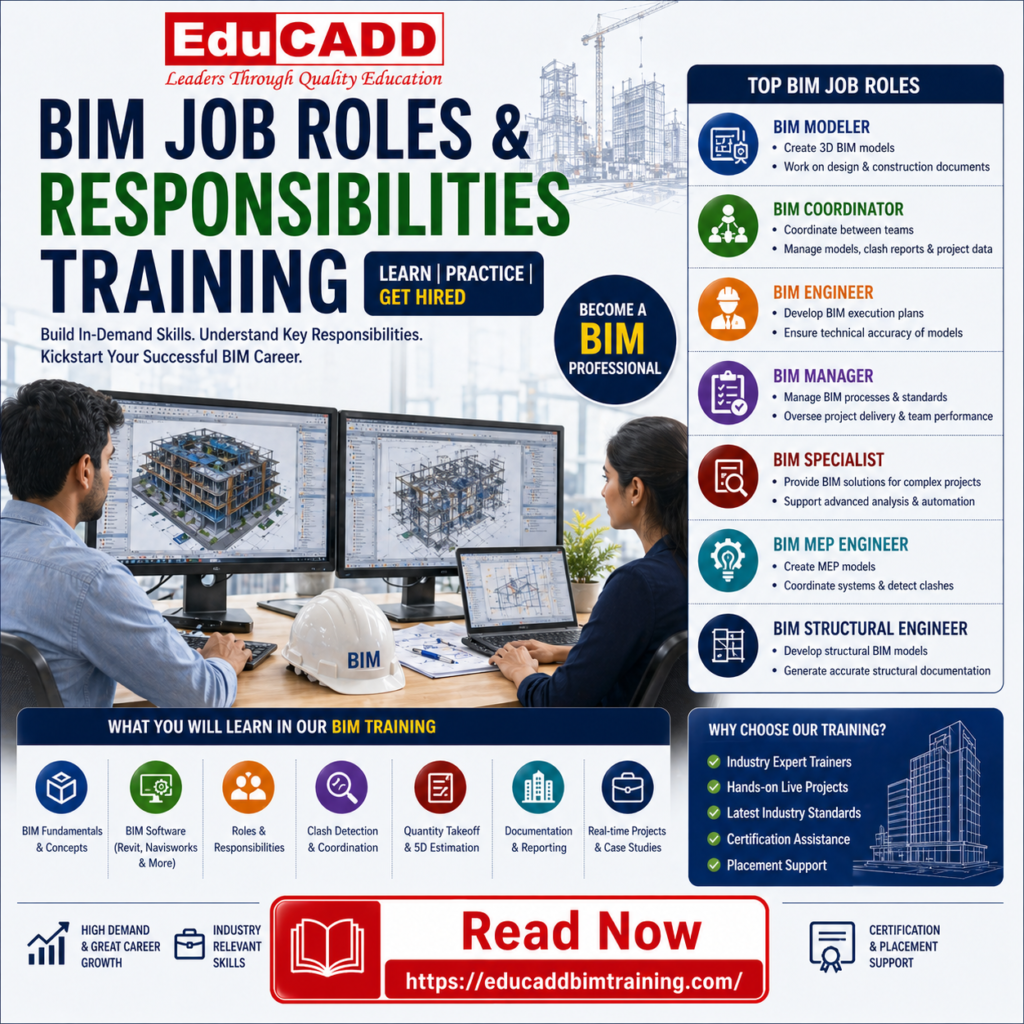
BIM offers a wide range of job roles, each with specific responsibilities. These roles vary depending on experience, skills, and project requirements. Common roles include BIM Modeler, BIM Coordinator, BIM Engineer, and BIM Manager.
Each role plays a crucial part in project success. Knowing these roles helps you choose the right career path. This knowledge is essential for BIM job roles and responsibilities training.
3. Role of a BIM Modeler
A BIM Modeler is responsible for creating detailed 3D models using BIM software. They work closely with design teams to develop accurate representations of buildings and structures.
Modelers must ensure that all elements are correctly placed and aligned. They also update models based on project changes. This role forms the foundation of BIM job roles and responsibilities training.
4. Responsibilities of a BIM Coordinator
A BIM Coordinator ensures smooth collaboration between different teams. They manage model coordination and resolve clashes between various systems such as structural and MEP components.
- Identifying and resolving design conflicts
- Coordinating between multiple disciplines
This role requires strong communication and problem-solving skills. It is a key part of BIM job roles and responsibilities training.
5. Role of a BIM Engineer
A BIM Engineer combines technical knowledge with practical application. They work on creating models, analyzing data, and supporting project execution.
BIM engineers also ensure that models meet project standards and requirements. Their role is more advanced compared to modelers. This makes it an important stage in BIM job roles and responsibilities training.
6. Responsibilities of a BIM Manager
A BIM Manager oversees the entire BIM process within a project. They manage teams, set standards, and ensure that workflows are followed correctly.
They also communicate with clients and stakeholders to meet project goals. This leadership role requires experience and expertise. It represents the highest level in BIM job roles and responsibilities training.
7. Skills Required for BIM Roles
To succeed in BIM roles, professionals must develop a combination of technical and soft skills. These skills help them perform tasks efficiently and collaborate effectively.
- Proficiency in BIM software tools
- Strong communication and teamwork abilities
Developing these skills is essential for completing BIM job roles and responsibilities training successfully.
8. Software Tools Used in BIM
BIM professionals use various software tools to perform their tasks. These tools help in modeling, coordination, and project management. Common tools include Revit, Navisworks, and AutoCAD.
Learning these tools is a key part of training. Practical knowledge of software improves job performance. This makes software training an important aspect of BIM job roles and responsibilities training.
9. Importance of Training in BIM Careers
Training plays a crucial role in preparing individuals for BIM careers. It provides hands-on experience and helps learners understand real-world workflows.
Proper training also improves confidence and job readiness. It ensures that candidates meet industry standards. This highlights the importance of BIM job roles and responsibilities training.
10. Career Growth in BIM
BIM offers excellent career growth opportunities. Professionals can start as modelers and gradually move into advanced roles such as coordinators and managers.
Each stage requires skill development and experience. This growth path makes BIM a promising career option. Understanding this progression is part of BIM job roles and responsibilities training.
11. Challenges in BIM Roles
Working in BIM comes with certain challenges. Professionals must handle complex projects and manage large amounts of data. Learning advanced tools can also be difficult initially.
However, these challenges can be overcome with practice and dedication. Facing these challenges is an important part of BIM job roles and responsibilities training.
12. Industry Demand for BIM Professionals
The demand for BIM professionals is increasing across the globe. Construction companies, design firms, and infrastructure projects are actively hiring skilled individuals.
This demand ensures job stability and growth opportunities. It also highlights the importance of BIM job roles and responsibilities training in today’s job market.
13. Future Trends in BIM
BIM is continuously evolving with new technologies such as Artificial Intelligence and Virtual Reality. These advancements are making BIM more efficient and powerful.
Professionals who stay updated with these trends will have better career opportunities. This forward-looking approach is a key part of BIM job roles and responsibilities training.
14. How to Start Your BIM Career
Starting a BIM career requires the right approach. First, choose a good training program that offers practical learning. Then, focus on gaining hands-on experience through projects.
Build a strong portfolio and apply for entry-level roles. Continuous learning will help you grow in your career. These steps complete your journey in BIM job roles and responsibilities training.
Conclusion
BIM is transforming the construction industry, creating new opportunities for skilled professionals. Understanding BIM job roles and responsibilities training is essential for building a successful career in this field. From modelers to managers, each role plays a vital part in project success.
With proper training, skill development, and continuous learning, you can achieve your career goals in BIM. As the demand for BIM professionals continues to grow, those who invest in the right training will enjoy long-term success and stability.