
Introduction
The construction industry is evolving rapidly, especially in a developing country like India. As projects become more complex, professionals are shifting toward advanced technologies to improve efficiency and reduce risks. One of the most discussed topics today is BIM vs traditional construction methods, as it highlights the difference between modern digital workflows and conventional practices.
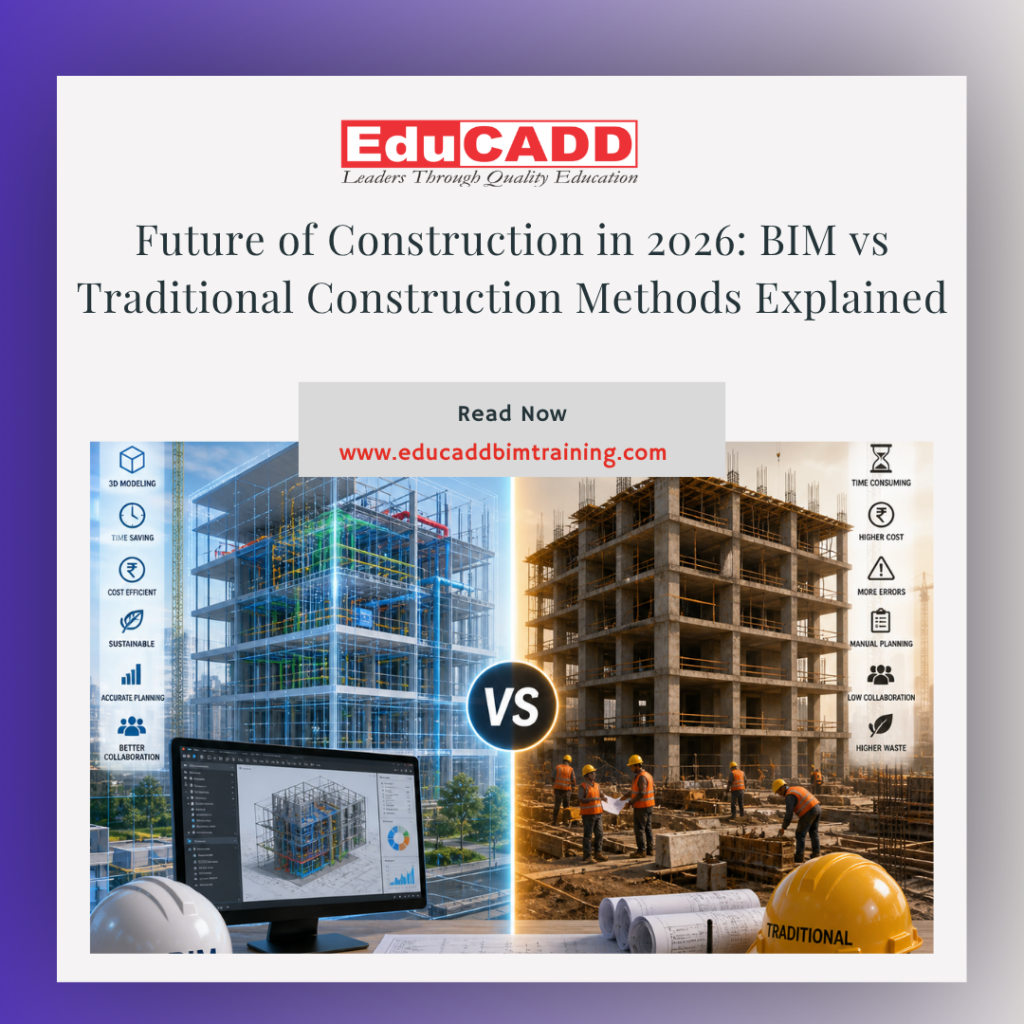
Traditional construction methods have been used for decades and rely heavily on manual processes and 2D drawings. On the other hand, BIM introduces a smarter approach by integrating design, data, and collaboration into a single platform. Tools like Autodesk Revit and Navisworks are transforming how projects are planned and executed. In this blog, we will explore the differences, benefits, challenges, and future scope of both approaches.
1. Understanding Traditional Construction Methods
Traditional construction methods rely on manual planning and execution.
Engineers and architects use 2D drawings to design projects. These methods have been widely used across India for many years.
2. Understanding BIM Technology
BIM stands for Building Information Modeling.
It involves creating intelligent 3D models that include both design and data. This modern approach improves collaboration and accuracy.
3. Planning and Design Approach
Traditional methods depend on separate drawings for each stage.
In contrast, BIM integrates all project information into a single model. This improves efficiency in the BIM vs traditional construction methods discussion.
4. Accuracy and Error Reduction
Traditional methods often lead to errors due to manual processes.
- Miscommunication between teams
- Errors in design interpretation
BIM reduces these issues by providing accurate and coordinated models.
5. Time Efficiency
Traditional construction takes more time due to manual coordination.
BIM speeds up the process by enabling real-time collaboration. This makes it a key factor in BIM vs traditional construction methods.
6. Cost Management
Cost estimation in traditional methods can be inaccurate.
BIM offers better cost control through detailed data and analysis.
7. Collaboration Between Teams
Traditional workflows often lack effective communication.
BIM allows teams to work on a shared platform, improving coordination and project outcomes.
8. Visualization and Design Clarity
Traditional methods rely on 2D drawings, which may be difficult to interpret.
- Limited visualization of final output
- Higher chances of misunderstanding
BIM provides 3D visualization, making designs easier to understand.
9. Risk Management
Traditional construction methods involve higher risks due to lack of coordination.
BIM helps identify potential issues early, reducing project risks.
10. Sustainability and Efficiency
Sustainability is a major concern in modern construction.
BIM supports energy-efficient designs and better resource management.
11. Skill Requirements
Traditional methods require basic drafting and engineering skills.
BIM requires advanced software knowledge and analytical skills, especially in tools like Autodesk Revit.
12. Industry Adoption
Traditional methods are still used in smaller projects.
However, BIM adoption is increasing rapidly in India. This trend strengthens the importance of BIM vs traditional construction methods.
13. Future Scope of Construction
The future of construction lies in digital transformation.
BIM will continue to grow as companies adopt smarter workflows and technologies.
14. Choosing the Right Approach
Choosing between BIM and traditional methods depends on project requirements.
- Traditional methods suit small-scale projects
- BIM is ideal for complex and large-scale projects
These points highlight the differences in BIM vs traditional construction methods.
Conclusion
The BIM vs traditional construction methods comparison clearly shows how the construction industry is shifting toward digital solutions. While traditional methods have served the industry for many years, they come with limitations in accuracy, efficiency, and collaboration.
BIM, on the other hand, offers a modern approach that improves project outcomes, reduces costs, and enhances teamwork. As the demand for efficient construction increases, BIM will play a crucial role in shaping the future of the industry.
Professionals who adapt to BIM technologies will have better career opportunities and growth prospects. By understanding the BIM vs traditional construction methods, you can make informed decisions and stay ahead in the evolving construction landscape.