
Introduction
The construction and design industry in India is undergoing a major transformation with the adoption of digital technologies. As professionals explore modern tools, many often get confused between different concepts. One of the most searched topics today is BIM vs 3D modeling difference, as it helps students and engineers understand the real value of each approach.
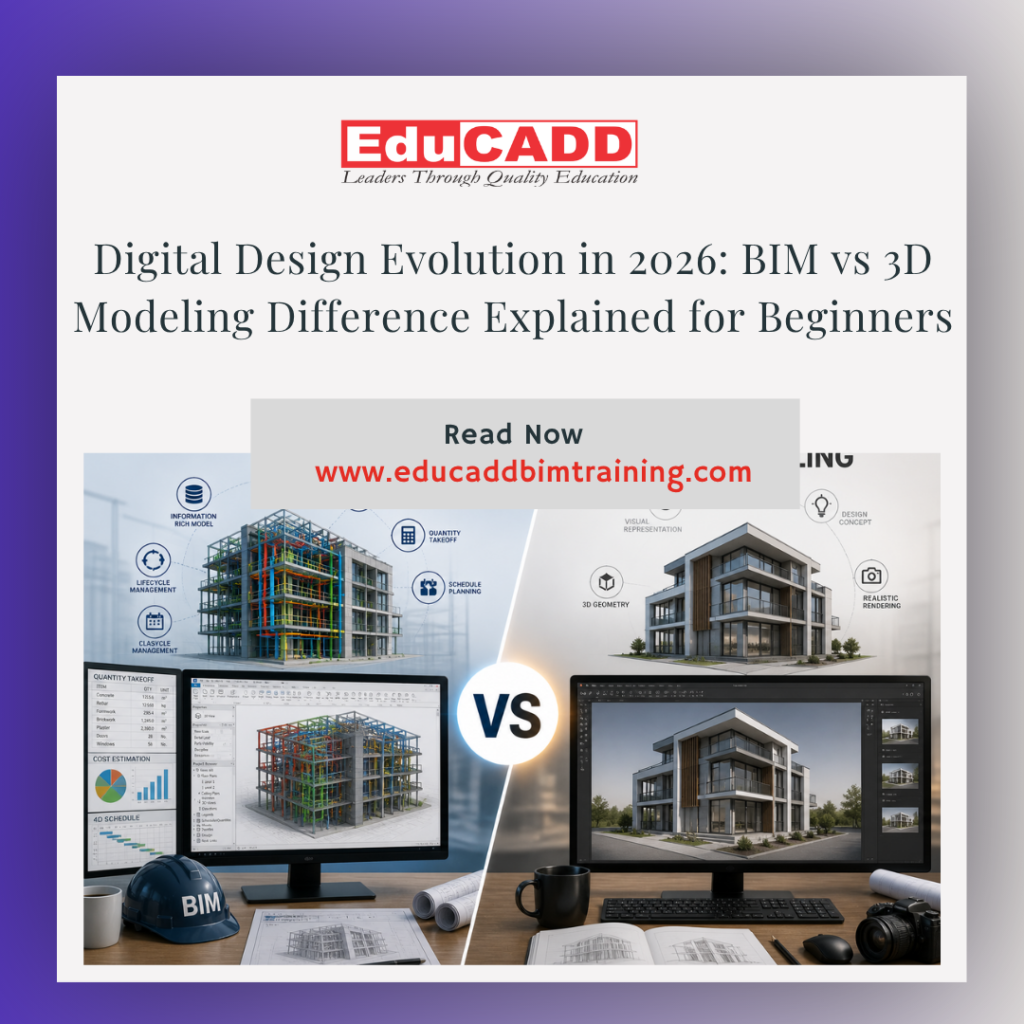
Although BIM and 3D modeling may seem similar, they serve different purposes in the construction process. While 3D modeling focuses on visual representation, BIM goes beyond by integrating data, coordination, and lifecycle management. Tools like Autodesk Revit and 3ds Max are widely used in these fields. In this blog, we will explore the key differences, benefits, and career implications to help you choose the right path.
1. Understanding 3D Modeling
3D modeling involves creating visual representations of objects or structures.
It focuses on design and aesthetics. This method is commonly used in architecture and visualization.
2. Understanding BIM
BIM stands for Building Information Modeling.
It includes both 3D design and detailed information about materials, costs, and timelines.
3. Purpose of 3D Modeling
3D modeling is mainly used for visualization and presentation.
- Helps clients understand the design
- Improves visual communication
This forms the base of the BIM vs 3D modeling difference.
4. Purpose of BIM
BIM is used for planning, designing, and managing construction projects.
It integrates multiple aspects of a project into one system.
5. Data Integration
3D modeling focuses only on geometry and design.
BIM includes data such as materials, cost, and scheduling. This highlights the difference between .
6. Collaboration
3D modeling involves limited collaboration.
BIM allows multiple teams to work on the same model, improving coordination.
7. Accuracy and Efficiency
3D models may lack detailed project information.
BIM provides accurate and data-rich models, reducing errors.
8. Software Tools Used
Different tools are used for 3D modeling and BIM.
- 3D modeling uses tools like 3ds Max
- BIM uses tools like Autodesk Revit
These tools define the BIM vs 3D modeling difference.
9. Application in Construction
3D modeling is used for design visualization.
BIM is used throughout the project lifecycle, from planning to execution.
10. Skill Requirements
3D modeling requires creative and design skills.
BIM requires technical knowledge and coordination abilities.
11. Career Opportunities
3D modeling offers roles in visualization and design.
BIM offers broader roles such as BIM Engineer and BIM Manager. This strengthens the BIM vs 3D modeling difference.
12. Industry Demand
Demand for BIM professionals is increasing in India.
3D modeling remains important but has a more limited scope.
13. Future Scope
The future of construction lies in BIM technology.
3D modeling will continue to support visualization tasks. This comparison is key in the BIM vs 3D modeling difference.
14. Choosing the Right Career Path
Choosing between BIM and 3D modeling depends on your goals.
- Choose 3D modeling for creative design roles
- Choose BIM for technical and high-growth careers
These points clarify the BIM vs 3D modeling difference.
Conclusion
The BIM vs 3D modeling difference clearly shows that both approaches play important roles in the construction industry. However, BIM offers a more advanced and comprehensive solution by integrating design, data, and collaboration.
While 3D modeling focuses on visual representation, BIM provides a complete project management approach. This makes BIM more valuable in modern construction workflows.
As the industry continues to adopt digital technologies, BIM will become increasingly important. By understanding the BIM vs 3D modeling difference, you can choose the right career path and build a successful future in the construction industry.