
Introduction
The construction industry is changing faster than ever. Architects, engineers, contractors, and project managers now use digital tools to plan, design, build, and manage projects. As projects become more complex, traditional methods alone are not enough. Professionals need better ways to understand buildings, manage information, reduce errors, and improve project performance. This is where BIM Digital Twin Training becomes highly valuable.
Building Information Modeling, or BIM, helps professionals create detailed digital models of buildings and infrastructure. Digital twin technology takes this concept further by connecting digital models with real-world information and operational data. Together, these technologies can support better decision-making throughout the project lifecycle.
For students and working professionals, BIM and digital twin training can provide practical knowledge of modern construction workflows. It can also help learners understand how digital models, data, software, and real-world assets work together. As the industry continues to adopt connected technologies, these skills can become an important part of a modern AEC career.
What Is BIM and Why Does It Matter?
Building Information Modeling is a digital approach used to create and manage information about a building or infrastructure project. A BIM model can contain geometry, materials, specifications, quantities, and other useful project information. Therefore, BIM is more than simply creating a 3D model.
Architects can use BIM to develop building designs. Structural engineers can coordinate structural elements. MEP professionals can plan mechanical, electrical, and plumbing systems. Contractors can use models for construction planning and coordination. Facility managers can also use project information after construction is completed.
This connected workflow can reduce communication gaps between different teams. It can also help identify design conflicts before they become expensive problems on the construction site.
Modern BIM Digital Twin Training introduces learners to this complete approach rather than focusing only on software commands. This helps students understand how digital models support real project decisions.
Understanding the Digital Twin Concept
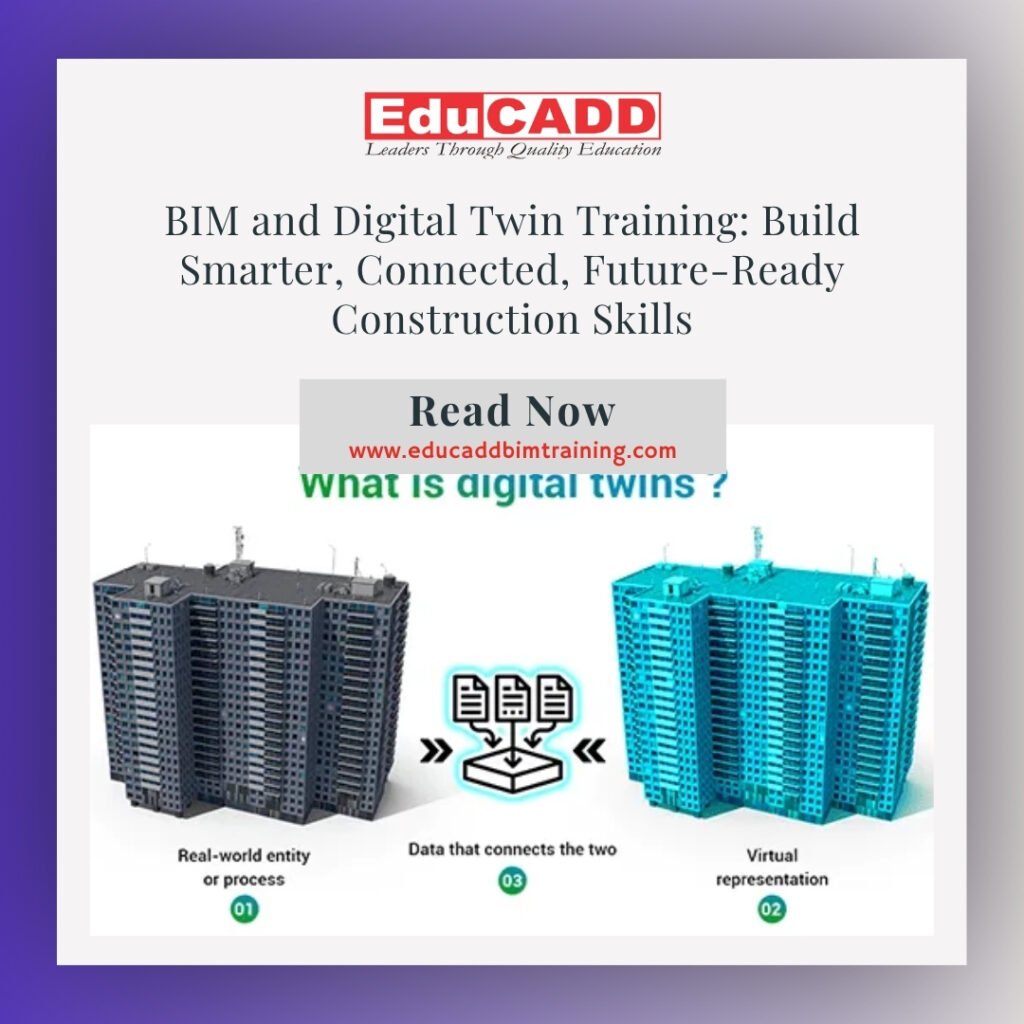
A digital twin is a digital representation of a physical asset, system, or environment. However, it is different from a standard 3D model. A BIM model mainly represents information about a planned or constructed asset. A digital twin can connect that digital representation with information from the physical asset.
For example, a building digital twin may use information related to equipment, energy use, maintenance, occupancy, or building performance. Sensors and connected systems can provide updated information. This allows teams to monitor conditions and make informed decisions.
Digital twins can be useful in buildings, factories, infrastructure, transportation systems, and other complex environments. As a result, professionals who understand both BIM and connected data workflows can work across different stages of the asset lifecycle.
How BIM and Digital Twin Technologies Work Together
BIM and digital twins are closely connected, but they serve different purposes. BIM focuses strongly on creating and managing structured project information. A digital twin extends the concept by connecting digital information with the physical asset and its changing conditions.
This relationship creates a powerful workflow. A BIM model can provide a strong digital foundation. Project information can then be connected with operational data. Over time, the digital environment can support monitoring, analysis, maintenance, and decision-making.
For learners, BIM Digital Twin Training can explain this connection through practical examples. Instead of learning isolated concepts, students can understand how information moves from design to construction and then into facility management.
What You Can Learn Through BIM and Digital Twin Training
A structured course can cover several areas of digital construction. The exact curriculum may differ between training providers. However, learners can expect exposure to important concepts, software, workflows, and project practices.
Key learning areas may include:
- BIM fundamentals and industry workflows
- 3D modeling and information management
- Architectural, structural, and MEP coordination
- Clash detection and design coordination
- BIM documentation and project collaboration
- Model-based quantity and project information
- Construction planning and visualization
- Digital twin fundamentals
- Connected asset information
- Data-driven facility management
- Real-time monitoring concepts
- Digital construction workflows
A good BIM and digital twin training program should balance theory with practical exercises. Learners should not only understand what BIM and digital twins mean. They should also understand how these technologies can be applied to realistic project situations.
BIM Software Skills for Modern Professionals
Software knowledge is an important part of BIM education. Different projects may use different platforms depending on their requirements. Revit, Navisworks, Civil 3D, Tekla Structures, and other digital tools are commonly associated with BIM workflows.
However, software knowledge alone does not create a strong BIM professional. Learners also need to understand modeling standards, coordination, project information, documentation, and collaboration.
For this reason, BIM Digital Twin Training should ideally combine software practice with industry-oriented workflows. Students can then understand why a particular tool is being used instead of simply learning where to find commands.
Practical training can also help learners become more confident when working on project-based assignments. They can explore how different disciplines interact and how a coordinated digital model can support project delivery.
Why Digital Twins Are Becoming Important
Construction does not end when a building is handed over. Buildings and infrastructure need regular monitoring, maintenance, upgrades, and management. Digital twin technology can help organizations maintain a digital connection with physical assets.
For example, facility teams can use digital information to understand equipment, spaces, systems, and maintenance requirements. Connected data can provide useful insights into asset performance.
This can support several activities, such as:
- Monitoring building systems
- Supporting preventive maintenance
- Tracking asset information
- Understanding equipment performance
- Improving operational planning
- Supporting energy management
- Identifying potential issues
- Improving facility documentation
Therefore, digital twin knowledge can expand the role of BIM beyond the design and construction stages.
Career Opportunities After BIM and Digital Twin Training
The growing use of digital construction technologies has created demand for professionals with specialized technical skills. Career opportunities depend on qualifications, software knowledge, project experience, and employer requirements.
Learners with BIM skills may explore roles such as:
- BIM Modeler
- BIM Coordinator
- BIM Engineer
- BIM Architect
- BIM Structural Modeler
- MEP BIM Modeler
- BIM Project Coordinator
- Digital Construction Professional
- VDC Professional
- Digital Twin Specialist
- Facility Information Management Professional
The exact responsibilities can vary between organizations. Some professionals focus heavily on modeling. Others work on coordination, standards, project management, data, or digital transformation.
Because of this variety, BIM Digital Twin Training can be useful for learners from different technical backgrounds. Architects, civil engineers, mechanical engineers, electrical engineers, construction professionals, and facility management professionals can all explore relevant applications.
Benefits for Students and Working Professionals
One major advantage of BIM and digital twin training is its practical connection to modern project workflows. Students can develop skills that go beyond traditional classroom learning.
For students, practical training can provide an introduction to industry software and digital project coordination. It can also help them create project-based work that demonstrates their skills.
For working professionals, training can provide an opportunity to update existing knowledge. Professionals who already understand construction processes can explore new digital methods and technologies.
Some important benefits include:
- Better understanding of digital construction
- Practical BIM software exposure
- Improved project coordination skills
- Stronger understanding of project information
- Knowledge of digital twin concepts
- Better awareness of modern industry workflows
- Opportunities to build a stronger professional portfolio
- Ability to understand multidisciplinary project coordination
Most importantly, continuous learning can help professionals stay familiar with changing technology and project practices.
BIM and Digital Twins in the Future of Construction
The future of construction is likely to become increasingly connected and data-driven. BIM, cloud collaboration, artificial intelligence, automation, IoT, and digital twins can work together to create more intelligent project environments.
Imagine a building where the digital model contains detailed asset information. Operational systems provide current data. Facility teams can review building conditions through a connected platform. Maintenance teams can access relevant asset information before starting a task.
This type of workflow can make project information more useful throughout the asset lifecycle.
However, technology alone does not solve every project challenge. Organizations also need skilled professionals, clear processes, accurate information, proper standards, and effective collaboration. Therefore, training remains an important part of successful digital transformation.
A strong BIM and digital twin training pathway can help learners understand both the technology and the workflow behind it.
How to Choose the Right BIM and Digital Twin Training Program
Choosing a training program requires more than checking the course title. Learners should examine the curriculum, practical exposure, software coverage, trainer experience, project work, and certification details.
Before joining a program, consider these factors:
- Does the course include practical BIM projects?
- Does it cover relevant BIM software?
- Does it explain multidisciplinary coordination?
- Does it introduce digital twin concepts clearly?
- Are learners given hands-on assignments?
- Does the course include real project examples?
- Are trainers experienced in industry workflows?
- Does the program offer certification?
- Is career or placement guidance available?
- Does the course match your career goals?
A good program should provide a clear learning path. It should also help learners understand how their skills can be applied in actual project environments.
The Role of Practical Projects in BIM Learning
Practical projects can make technical training more meaningful. Instead of learning software tools separately, students can work on a complete project and understand how different stages connect.
For example, a learner could create an architectural model and then explore structural or MEP coordination. The learner could identify clashes, prepare documentation, and review project information.
Digital twin concepts can then introduce another layer. Learners can explore how asset information may be connected to operational data and how digital information can support facility management.
This practical approach makes BIM and digital twin training more relevant to real-world applications. It also gives learners a chance to develop problem-solving and coordination skills.
BIM and Digital Twin Skills for a Data-Driven Industry
The construction sector is no longer based only on drawings and physical documentation. Projects now generate large amounts of digital information. Managing this information effectively can improve collaboration and decision-making.
BIM provides a structured environment for project information. Digital twins can extend that information into the operational stage. Together, they create opportunities for more connected workflows.
Professionals who understand these concepts can contribute to digital transformation within architecture, engineering, construction, infrastructure, and facility management organizations.
As technology develops, learners may also encounter AI-assisted design, automated model checking, cloud-based collaboration, IoT systems, predictive analytics, and other emerging tools. Understanding the fundamentals of BIM and digital twins can provide a strong foundation for exploring these technologies.
Conclusion
The construction industry is moving toward smarter, connected, and information-driven workflows. BIM is helping professionals improve design coordination, project information, and collaboration. Digital twins are extending digital models into the operational world by connecting digital information with physical assets and real-world data.
For students and professionals who want to develop modern construction technology skills, BIM Digital Twin Training can provide valuable knowledge of these evolving workflows. Practical learning can help learners understand software, coordination, information management, digital models, and connected asset concepts.
The most important goal is not simply to learn another software tool. It is to understand how digital information can improve the way projects are designed, delivered, operated, and maintained. With the right training and practical experience, learners can prepare themselves for an industry where digital skills are becoming increasingly important.