
The construction and infrastructure industry is undergoing a powerful digital transformation. Traditional methods are slowly giving way to smarter, faster, and more efficient technologies. One of the most important innovations leading this change is Building Information Modeling, widely known as BIM. Today, students and professionals are actively searching to understand BIM course job scope and how it can shape their careers. As demand for skilled professionals continues to rise, understanding what is BIM course and job scope has become essential for anyone entering the civil engineering or construction field.
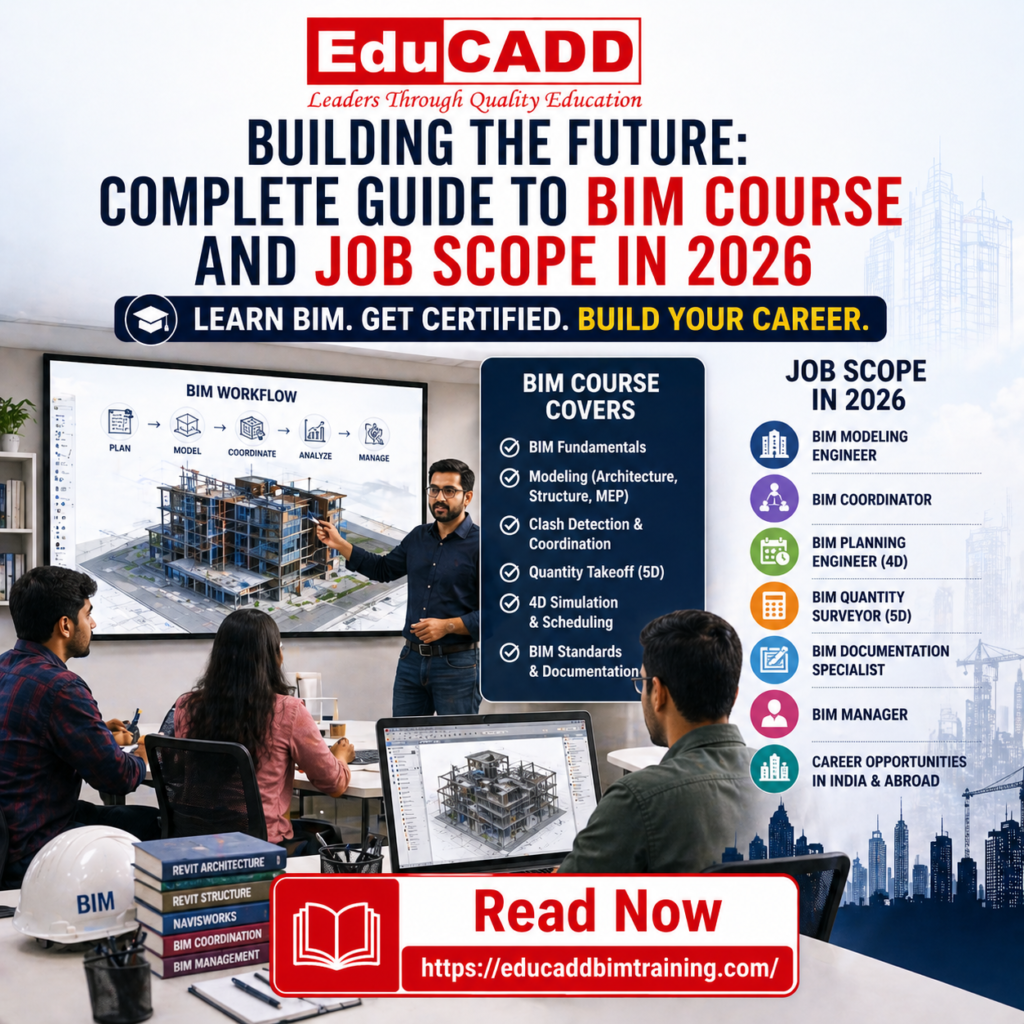
A BIM course equips learners with the technical and practical knowledge required to design, manage, and execute construction projects using advanced digital tools. At the same time, the job scope in BIM is expanding rapidly across the globe. From design firms to construction companies, every sector now seeks professionals who can handle BIM workflows efficiently. In this blog, we will explore in detail BIM course job scope and why it matters in 2026 and beyond.
1. What is a BIM Course?
A BIM course is a professional training program that teaches students how to use digital tools and processes for construction project management. It focuses on creating intelligent 3D models that include both physical and functional information of a building or infrastructure project. Unlike traditional CAD courses, BIM training goes beyond drafting and introduces a data-driven approach to design and execution.
Students learn how to integrate different aspects of a project, such as architecture, structure, and MEP systems, into a single model. This integration improves coordination and reduces errors during construction. Understanding this foundation helps clarify what is BIM course and job scope in real-world applications.
2. Key Components Covered in a BIM Course
A BIM course includes a wide range of topics that prepare students for real-world projects. These components ensure that learners gain both technical and practical knowledge.
- 3D modeling and design using BIM software
- Project coordination and clash detection
In addition, students learn about 4D scheduling and 5D cost estimation. These advanced concepts help them understand how time and cost are integrated into project models. These learning areas directly answer BIM course job scope in practical terms.
3. Importance of BIM in Modern Construction
BIM plays a crucial role in modern construction by improving efficiency and reducing project risks. It allows engineers to visualize the entire project before construction begins. This early visualization helps identify potential issues and resolve them in advance.
Moreover, BIM enhances collaboration among different teams. Architects, engineers, and contractors can work together on a shared platform. This approach improves communication and reduces misunderstandings. These benefits clearly define what is BIM course and job scope in today’s industry.
4. Software Tools Learned in a BIM Course
A BIM course provides hands-on training in industry-standard software tools. These tools help students create, analyze, and manage construction models effectively. Commonly used software includes Revit, Navisworks, and Civil 3D.
Learning these tools improves technical skills and increases job opportunities. Employers prefer candidates who have practical experience with BIM software. This technical exposure strengthens the understanding of what is BIM course and job scope.
5. Skills Developed Through a BIM Course
A BIM course helps students develop a wide range of skills that are essential for their careers. These skills go beyond technical knowledge and include problem-solving and communication abilities.
Students learn how to analyze project data and make informed decisions. They also develop teamwork skills, which are important for working in collaborative environments. These abilities are key to understanding what is BIM course and job scope in professional settings.
6. Duration and Types of BIM Courses
BIM courses are available in different formats, depending on the learner’s needs. Some courses are short-term, lasting a few months, while others are advanced diploma programs that take longer to complete.
- Short-term certification courses for beginners
- Advanced programs for specialization
Choosing the right course depends on career goals and prior knowledge. These options give a clear picture of what is BIM course and job scope for different learners.
7. Job Roles After Completing a BIM Course
One of the biggest advantages of a BIM course is the wide range of job opportunities it offers. After completing the course, students can explore various roles in the construction and design industry.
Common job roles include BIM Modeler, BIM Coordinator, BIM Engineer, and BIM Manager. Each role has specific responsibilities, such as creating models, coordinating teams, and managing project data. These roles highlight what is BIM course and job scope in terms of career paths.
8. Industries That Hire BIM Professionals
BIM professionals are in demand across multiple industries. These include construction companies, architectural firms, infrastructure development organizations, and real estate companies.
In addition, government projects and smart city initiatives are increasing the demand for BIM experts. This wide demand clearly explains what is BIM course and job scope across industries.
9. Salary Expectations in BIM Careers
Salary is an important factor when choosing a career path. BIM professionals often receive competitive salaries due to their specialized skills. Entry-level positions offer decent pay, while experienced professionals earn significantly higher salaries.
As skills and experience increase, professionals can move into senior roles with better compensation. This growth helps illustrate BIM course job scope from a financial perspective.
10. Global Demand for BIM Professionals
The demand for BIM professionals is not limited to one country. It is growing globally, especially in regions with large infrastructure projects. Countries in the Middle East, Europe, and North America are actively hiring skilled BIM experts.
This global demand opens opportunities for professionals to work internationally. Therefore, it expands the meaning of what is BIM course and job scope beyond local opportunities.
11. Advantages of Choosing a BIM Career
Choosing a career in BIM offers several advantages. It provides job stability, career growth, and opportunities to work on innovative projects. Professionals also get the chance to work with advanced technologies.
Moreover, BIM careers are future-focused because the industry continues to evolve. These benefits strongly support what is BIM course and job scope as a career choice.
12. Challenges in Learning BIM
While BIM offers many benefits, learning it can be challenging. Students may find it difficult to understand complex software and workflows at the beginning. However, consistent practice and proper guidance can help overcome these challenges.
With time, learners become confident in using BIM tools. This journey reflects the reality of what is BIM course and job scope and the effort required to succeed.
13. Future Trends in BIM Technology
BIM is continuously evolving with new technologies such as Artificial Intelligence and Virtual Reality. These innovations are making BIM more efficient and powerful.
In the future, BIM will play a key role in smart cities and sustainable construction. These trends further define what is BIM course and job scope in the coming years.
14. How to Start a Career in BIM
Starting a career in BIM requires the right strategy. First, choose a reliable training institute that offers practical exposure. Then, focus on building hands-on experience through projects.
Creating a strong portfolio and networking with professionals also helps. These steps clearly show what is BIM course and job scope in terms of career entry.
Conclusion
The construction industry is moving towards a digital future, and BIM is at the center of this transformation. Understanding BIM course job scope can open doors to exciting career opportunities. From technical skills to global demand, BIM offers a complete career pathway.
As we move forward into 2026, the demand for BIM professionals will continue to grow. Those who invest in learning and upgrading their skills will gain a strong advantage. Clearly, what is BIM course and job scope is not just a question—it is a powerful career decision that can shape a successful future.