
The construction industry is changing rapidly as technology reshapes how buildings and infrastructure are planned, designed, constructed, and managed. At the center of this transformation is Building Information Modeling Education called BIM. It connects design information, project data, and collaboration through a coordinated digital model.
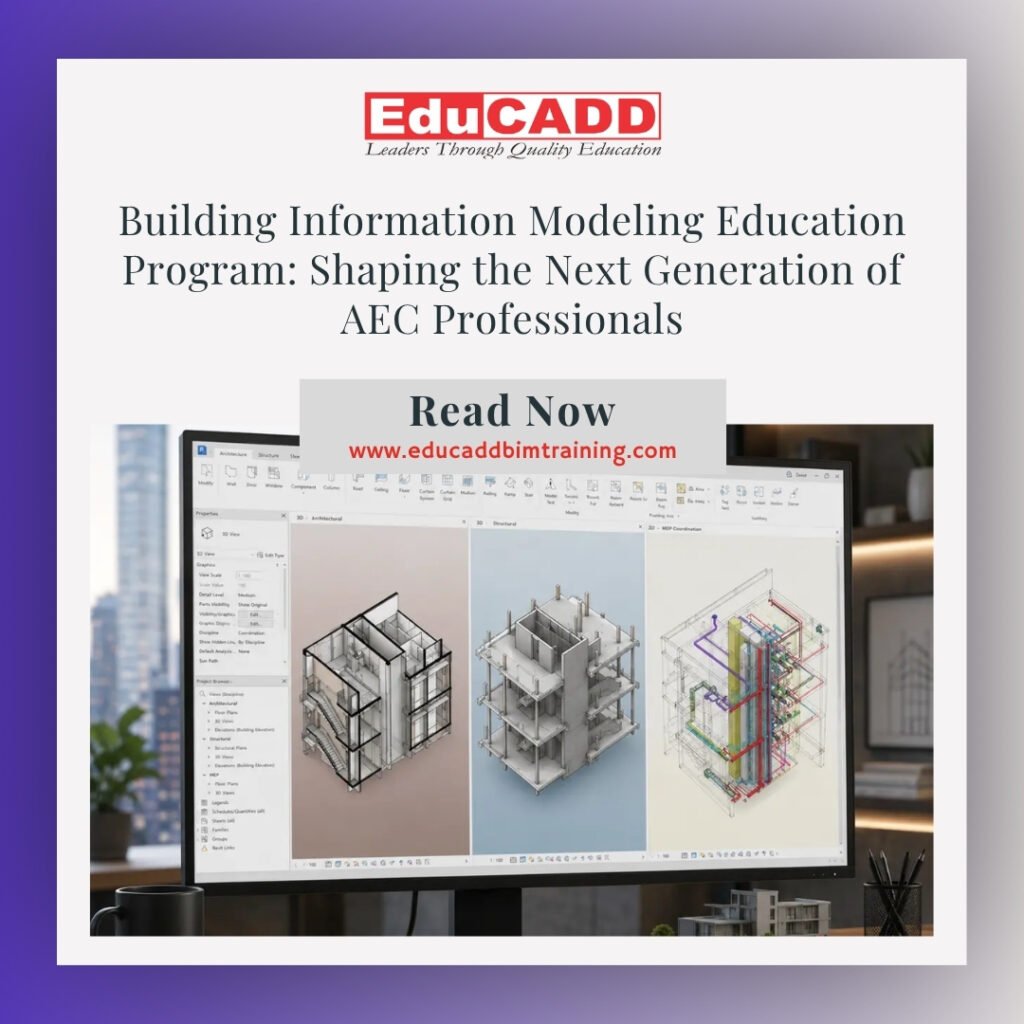
A Building Information Modeling Education Program helps students and professionals understand this modern approach while developing practical skills for real projects. As demand for digital construction expertise grows, structured BIM education can create valuable career opportunities.
Why BIM Education Matters in Today’s Industry
Traditional construction workflows often depend on separate drawings, documents, and disconnected teams. This can create communication gaps, design conflicts, delays, and costly revisions. BIM brings project information into a coordinated environment, allowing architects, engineers, contractors, and other professionals to work with greater clarity.
A Building Information Modeling Education Program introduces learners to this collaborative process and explains how digital information can support better decisions throughout a project lifecycle. Therefore, BIM education has become increasingly valuable for students entering the AEC industry.
Learning the Core Principles of BIM
A strong BIM learning journey begins with the fundamentals. Students need to understand model-based design, project information, levels of development, coordination, documentation, and information exchange. They also learn how different disciplines contribute to a shared project environment.
Quality Building Information Modeling Education explains these principles through practical examples rather than focusing only on software commands. This foundation helps learners understand why BIM matters and how it supports planning, design, construction, operation, and long-term asset management.
Developing Practical Software Skills
BIM careers require more than theoretical knowledge. Professionals must confidently use industry-relevant software to create, modify, review, and coordinate digital models. Depending on their career path, learners may work with architectural, structural, MEP, coordination, visualization, and documentation tools.
A practical Building Information Modeling Education Program should provide guided exercises, project-based assignments, and repeated software practice. Consequently, students can move from basic commands to complete workflows while gaining the confidence needed to handle professional project requirements.
Understanding Multidisciplinary Coordination
One of BIM’s greatest advantages is its ability to connect different disciplines. Architectural, structural, mechanical, electrical, and plumbing models can be coordinated to identify problems before construction begins. Learners should understand how clashes occur, how coordination reviews work, and how design changes affect other disciplines. Through practical BIM training, students can practice identifying conflicts and communicating solutions. This experience develops both technical ability and teamwork, which are essential for successful BIM implementation on complex projects.
Building Skills Through Realistic Projects
Project-based learning can make BIM education more meaningful. Instead of completing isolated software exercises, learners can develop a complete building model from an initial concept to coordinated documentation. They can practice creating views, schedules, sheets, families, model components, and project information.
A Building Information Modeling Education Program that uses realistic assignments allows students to experience the sequence of professional work. Moreover, project experience gives learners portfolio material that can demonstrate their abilities during internships, interviews, and job applications.
Exploring BIM Across the Project Lifecycle
BIM is not limited to the design stage. Its value extends into construction planning, quantity estimation, scheduling, facility management, and asset information. Students should understand how model data can support decisions at different stages of a project. A well-structured BIM education program introduces these wider applications so learners see the complete picture. As a result, they can understand how BIM contributes to efficiency, coordination, cost control, communication, and informed decision-making beyond traditional design documentation.
Connecting BIM With Emerging Technologies
The future of construction technology is becoming increasingly connected. BIM now works alongside tools and methods such as cloud collaboration, reality capture, digital twins, automation, artificial intelligence, and advanced visualization. Learners who understand these connections can adapt more easily as industry practices evolve.
A Building Information Modeling Education Program should encourage curiosity about emerging technologies while maintaining strong fundamentals. This balanced approach helps students build skills that remain useful even when specific software platforms and workflows continue to change.
Improving Career Readiness
BIM skills can support a wide range of professional roles. Depending on their interests, learners may pursue opportunities as BIM modelers, BIM coordinators, architectural designers, structural modelers, MEP professionals, BIM engineers, or project technology specialists. Career readiness also requires communication, problem-solving, documentation, and teamwork. A Building Information Modeling Education Program can combine technical training with professional practices to prepare learners for workplace expectations. In addition, portfolio development and practical project exposure can help candidates present their capabilities effectively.
Why Certification Can Add Professional Value
Certification can provide a structured way to demonstrate learning and technical competency. While certification alone does not replace practical experience, it can strengthen a professional profile when supported by real project skills. Learners should choose programs that focus on relevant software, industry workflows, assignments, and assessment.
A Building Information Modeling Education Program with meaningful evaluation can help students identify gaps and measure progress. Furthermore, a recognized credential may give employers an additional indication of a candidate’s commitment to professional development.
Choosing the Right BIM Education Program
Not every BIM course offers the same learning experience. Before enrolling, students should evaluate the curriculum, trainer expertise, practical exposure, software coverage, project assignments, and support available after training. They should also check whether the program reflects current industry practices instead of teaching software in isolation. The right BIM education program should balance concepts, tools, coordination, documentation, and project delivery. Ultimately, learners should select education that develops skills they can apply confidently in real professional environments.
The Role of Trainers and Industry Exposure
Effective instruction can significantly influence the quality of BIM learning. Experienced trainers can explain complex workflows, demonstrate practical methods, review student models, and provide feedback on mistakes. Industry exposure adds another valuable layer by showing learners how BIM teams communicate and solve project challenges.
A Building Information Modeling Education Program becomes more effective when instructors connect classroom concepts with workplace situations. Therefore, students should look for learning environments where questions, practice, feedback, and continuous improvement are encouraged.
Preparing for a Digital Construction Future
The AEC sector is moving toward more connected, data-driven, and collaborative project delivery. Employers increasingly need professionals who can work with digital models and understand information beyond basic drafting. Students who begin learning BIM early can develop a strong foundation for adapting to this environment. A Building Information Modeling Education Program can support that preparation by combining technical knowledge, project practice, coordination skills, and awareness of emerging technologies. With consistent learning, professionals can remain competitive as construction workflows become more digital.
Building a Stronger Professional Future With BIM
Choosing BIM education is not simply about learning another software platform. It is about understanding a new way of planning, communicating, coordinating, and delivering projects. A Building Information Modeling Education Program can help learners develop practical capabilities that connect design knowledge with modern construction processes.
With the right curriculum, experienced guidance, hands-on projects, and continuous practice, students can build a strong professional foundation. Ultimately, BIM education can open the door to a more efficient, collaborative, and technology-driven future in the AEC industry.
Conclusion
Building Information Modeling Education is transforming the AEC industry by making project planning, design, coordination, and construction more connected and efficient. A well-structured Building Information Modeling Education Program helps students and professionals develop practical skills while understanding how digital workflows support real-world projects.
From BIM modeling and multidisciplinary coordination to emerging technologies and career development, comprehensive training can create a strong foundation for professional growth. As the demand for digitally skilled AEC professionals continues to increase, investing in quality BIM education can help learners stay competitive, adapt to industry changes, and build rewarding careers in the future.