
Introduction
Infrastructure growth in India is accelerating rapidly due to urban expansion, industrial development, and increased transportation needs. Highways and bridges form the backbone of national connectivity, and their efficient design is essential for economic progress. However, traditional design methods often struggle with accuracy, coordination, and long-term sustainability. To overcome these challenges, digital technologies are now being widely adopted. One of the most powerful innovations in this field is BIM for highway and bridge design, which enables engineers to create smarter, safer, and more efficient infrastructure systems.
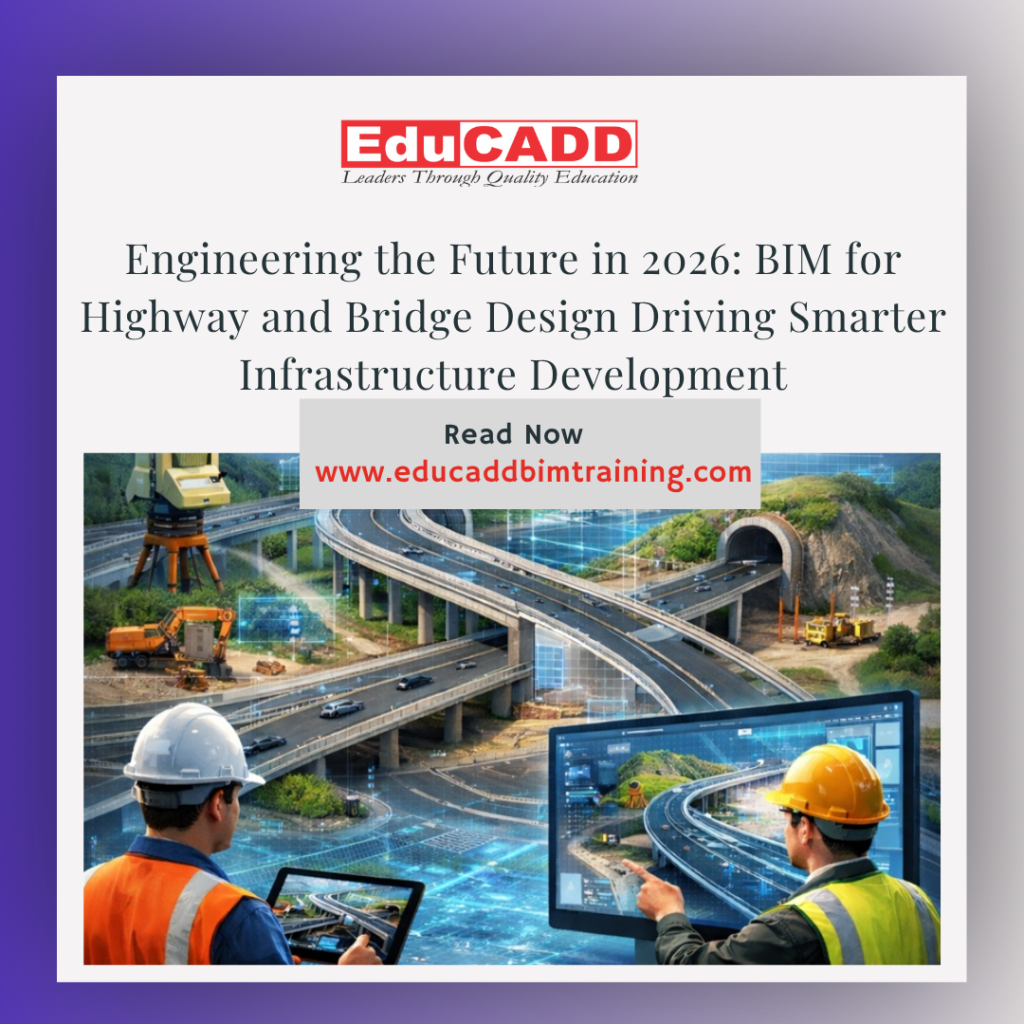
Building Information Modeling provides a data-driven platform where engineers can design, simulate, and optimize complex transportation structures. Tools like Autodesk Revit and Navisworks help manage design coordination, clash detection, and structural analysis. In this blog, we will explore how BIM is transforming highway and bridge design and why it is becoming essential for modern infrastructure development.
1. Understanding BIM in Transportation Infrastructure
BIM is a digital modeling process that integrates design, data, and construction information into a single system. In transportation projects, it helps engineers visualize highways and bridges in a detailed 3D environment.
This allows better planning and reduces design errors. Engineers can analyze terrain, traffic flow, and structural requirements before construction begins.
This makes BIM for highway and bridge design a powerful tool for improving infrastructure quality and efficiency.
2. Importance of Highways and Bridges in Development
Highways and bridges are critical for economic growth and regional connectivity. They support trade, transportation, and mobility across cities and states.
Efficient design ensures safety, durability, and cost-effectiveness. Poor planning can lead to delays and increased maintenance costs.
BIM helps address these challenges by improving accuracy and coordination in infrastructure projects.
3. Enhanced Design Accuracy and Precision
BIM improves design accuracy by providing detailed 3D models. Engineers can analyze structural components and make precise adjustments.
This reduces errors during construction and improves overall quality.
Additionally:
- Improve alignment and gradient accuracy in highways
- Ensure structural stability in bridge components
These features help create reliable and efficient infrastructure systems.
4. Terrain Analysis and Site Planning
Highway and bridge construction requires detailed terrain analysis. BIM enables engineers to study geographical conditions and environmental factors.
They can identify challenges such as slopes, soil conditions, and water bodies.
This helps in selecting the best construction approach and reduces risks during execution.
5. Structural Design and Simulation
BIM allows engineers to simulate structural performance under different conditions. This helps in evaluating load-bearing capacity and durability.
For bridges, engineers can test stress distribution and material behavior.
Simulation ensures that structures meet safety standards and perform efficiently over time.
6. Clash Detection and Error Prevention
Clash detection is a key feature of BIM. Tools like Navisworks automatically identify conflicts between structural and utility systems.
Engineers can resolve these issues before construction begins.
This reduces rework, saves time, and improves project efficiency.
7. Improved Collaboration in Infrastructure Projects
Highway and bridge projects involve multiple stakeholders, including engineers, contractors, and government authorities.
BIM provides a shared platform for collaboration. All teams can access real-time project data.
This improves communication and ensures better coordination throughout the project lifecycle.
8. Cost Estimation and Budget Optimization
Accurate cost estimation is essential for large infrastructure projects. BIM provides detailed quantity takeoffs and financial analysis.
Engineers can track expenses and optimize budgets effectively.
For example:
- Reduce material wastage through precise calculations
- Identify cost-saving opportunities during design phase
This improves financial efficiency and project planning.
9. Time Management and Construction Scheduling
BIM integrates design and scheduling to improve project timelines. Engineers can plan construction phases more effectively.
This helps identify delays and optimize workflows.
Better scheduling ensures timely completion of highway and bridge projects.
10. Sustainability in Transportation Infrastructure
Sustainability is becoming increasingly important in infrastructure development. BIM supports eco-friendly design practices.
Engineers can analyze environmental impact and optimize material usage.
This reduces carbon footprint and supports sustainable development goals.
11. Integration with Advanced Technologies
BIM integrates with technologies like AI, IoT, and GIS to enhance infrastructure design.
Tools like Autodesk Revit help engineers analyze complex data and improve decision-making.
Integration improves efficiency and enables smarter infrastructure planning.
12. Safety and Risk Management
Safety is a top priority in highway and bridge construction. BIM helps identify potential risks and design safer structures.
Engineers can simulate accident scenarios and improve safety measures.
This reduces construction risks and enhances long-term structural safety.
13. Career Opportunities in BIM Infrastructure Design
The demand for BIM professionals in transportation infrastructure is growing rapidly. Companies are seeking skilled engineers for highway and bridge projects.
Learning BIM for highway and bridge design opens opportunities in design, planning, and project management.
It also offers better salary prospects and career advancement.
14. Challenges and Future Scope
Despite its benefits, BIM adoption in infrastructure projects faces challenges such as high costs and skill gaps.
Engineers need proper training and advanced tools to implement BIM effectively.
However, the future is promising. Continuous technological advancements will make BIM more accessible and efficient, strengthening BIM for highway and bridge design.
Conclusion
The future of infrastructure development is becoming more digital and intelligent. BIM is transforming how highways and bridges are designed, planned, and constructed.
Understanding BIM for highway and bridge design is essential for engineers who want to stay relevant in the modern construction industry. It improves accuracy, efficiency, and sustainability in infrastructure projects.
As development continues to grow in India, professionals who adopt BIM for highway and bridge design will lead the future of transportation infrastructure and contribute to building safer, smarter, and more connected networks.