
Introduction
Urban development in India is undergoing a major transformation as cities aim to become smarter, more efficient, and sustainable. Rapid population growth, increasing infrastructure demands, and environmental challenges are forcing governments and planners to rethink traditional development methods. Conventional planning approaches often lack coordination, real-time data, and scalability. As a result, advanced technologies are becoming essential for modern urban development. One of the most impactful innovations in this space is BIM for smart cities India, which integrates digital modeling with data-driven decision-making.
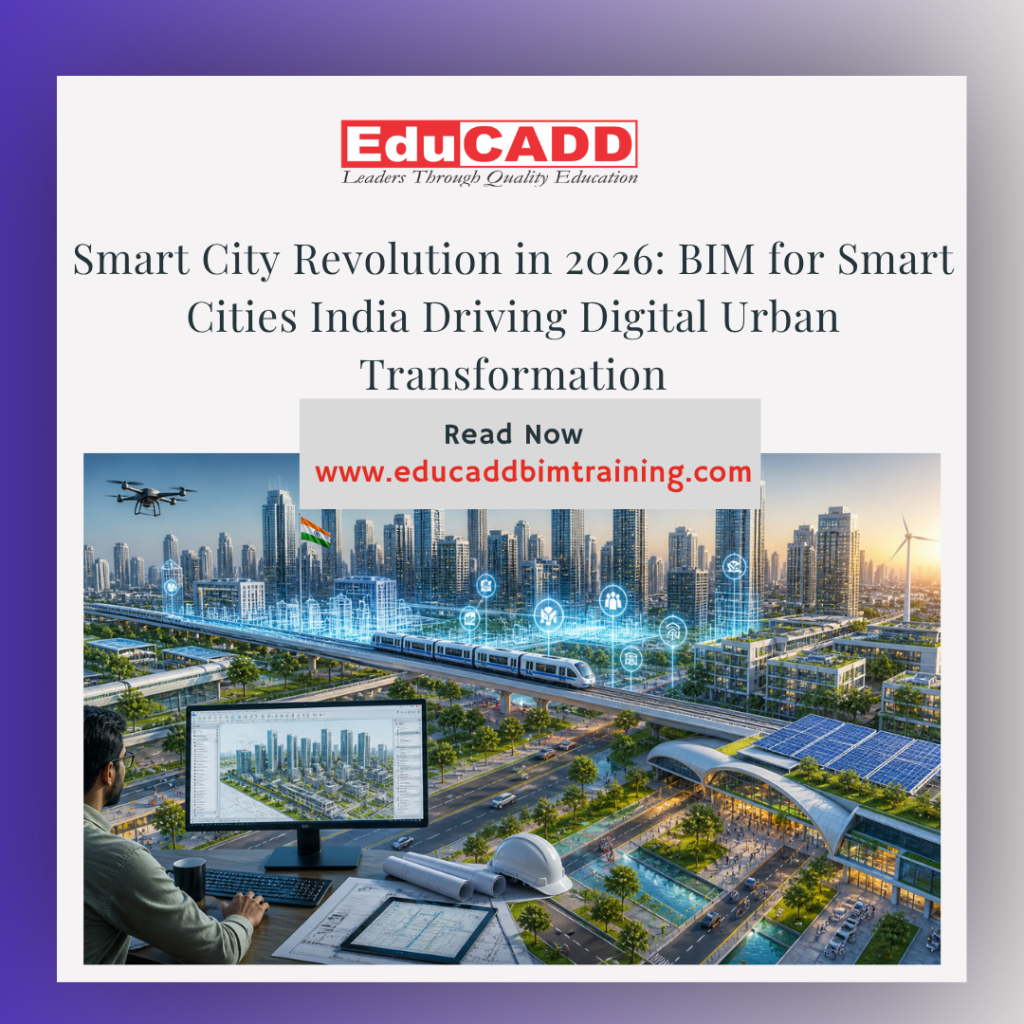
Building Information Modeling provides a centralized digital platform where all aspects of a city’s infrastructure can be planned, analyzed, and managed. Engineers, urban planners, and government authorities can collaborate efficiently using tools like Autodesk Revit and Navisworks. This blog explores how BIM is transforming smart cities and why it is becoming a critical component of future urban planning.
1. Understanding Smart Cities and BIM
Smart cities use advanced technologies to improve infrastructure, services, and overall quality of life. They rely on data, connectivity, and automation to enhance efficiency and sustainability.
BIM plays a vital role by creating a digital representation of urban systems. Engineers can visualize buildings, roads, utilities, and public spaces in a single model.
Furthermore, BIM allows planners to simulate different scenarios and evaluate outcomes before implementation. This reduces risks and improves planning accuracy. Therefore, BIM for smart cities India serves as a foundation for intelligent and data-driven urban development.
2. Evolution of Urban Planning
Urban planning has evolved significantly from manual drafting to advanced digital modeling. Earlier, planners relied on static drawings and limited datasets, which often led to inefficiencies.
With the introduction of BIM, planning became more dynamic and data-driven. Engineers could analyze designs and optimize layouts more effectively.
Today, smart city planning integrates BIM with technologies like IoT and AI. This evolution allows cities to adapt quickly to changing needs and ensures long-term sustainability.
3. Infrastructure Planning and Design
Infrastructure is the backbone of any smart city. BIM enables detailed planning and design of roads, bridges, buildings, and utilities.
Engineers can create accurate models and test different design options. This ensures optimal use of space and resources.
Additionally:
- Design integrated infrastructure systems for seamless connectivity
- Improve planning for public amenities like parks, schools, and hospitals
These capabilities enhance urban functionality and ensure efficient development.
4. Improved Data Management and Integration
Smart cities generate vast amounts of data from various sources. Managing this data efficiently is essential for decision-making.
BIM provides a centralized platform where data from different systems can be integrated and analyzed.
This enables engineers to access real-time information and make informed decisions. As a result, BIM for smart cities India improves coordination and enhances project efficiency across multiple departments.
5. Enhanced Collaboration Among Stakeholders
Smart city projects involve multiple stakeholders, including government agencies, private developers, engineers, and contractors.
BIM enables seamless collaboration by providing a shared digital environment. All stakeholders can access the same information and work together effectively.
This reduces miscommunication and ensures alignment with project goals. Improved collaboration also speeds up project execution and reduces errors.
6. Real-Time Monitoring and Management
Real-time monitoring is a key feature of smart cities. BIM integrates with IoT devices to collect and analyze data from infrastructure systems.
Engineers can monitor performance, identify issues, and take corrective actions instantly.
This proactive approach improves efficiency and reduces maintenance costs. It also ensures better management of city operations.
7. Sustainable Urban Development
Sustainability is a core objective of smart cities. BIM supports eco-friendly design and efficient resource management.
Engineers can analyze energy consumption, carbon emissions, and environmental impact during the planning stage.
This helps create sustainable and resilient urban environments. Additionally, it ensures compliance with environmental regulations and standards.
8. Transportation and Mobility Planning
Efficient transportation systems are essential for smart cities. BIM helps design and optimize traffic flow, public transport, and road networks.
Engineers can simulate traffic patterns and identify congestion points.
For example:
- Develop smart traffic management systems
- Improve last-mile connectivity and public transit efficiency
These improvements enhance mobility and reduce travel time for residents.
9. Energy Management and Efficiency
Energy management is critical for smart city infrastructure. BIM enables detailed analysis of energy usage across buildings and utilities.
Engineers can design energy-efficient systems and integrate renewable energy sources.
This reduces operational costs and environmental impact. It also supports long-term sustainability goals.
10. Water and Waste Management
Efficient water and waste management systems are essential for urban sustainability. BIM helps design optimized pipelines, drainage systems, and recycling facilities.
Engineers can analyze water usage and identify areas for improvement.
This ensures proper resource utilization and reduces environmental impact. Effective management improves living conditions and supports sustainable growth.
11. Integration with Advanced Technologies
BIM integrates with advanced technologies such as AI, IoT, and cloud computing to enhance smart city capabilities.
Tools like Autodesk Revit enable automation and intelligent analysis.
These integrations allow real-time data processing and predictive decision-making. This improves efficiency and innovation in urban planning.
12. Safety and Risk Management
Safety is a major concern in urban development. BIM helps identify potential risks and improve safety measures.
Engineers can simulate disaster scenarios such as floods or earthquakes and plan preventive strategies.
This reduces risks and ensures safer environments for residents. It also improves emergency response planning.
13. Career Opportunities in Smart City Development
The demand for professionals skilled in BIM and smart city technologies is growing rapidly. Companies are looking for engineers who can manage digital infrastructure projects.
Learning BIM for smart cities India opens opportunities in urban planning, infrastructure design, and project management.
It also provides better career growth, job stability, and higher earning potential.
14. Challenges and Future Scope
Smart city development comes with challenges such as high costs, technical complexity, and the need for skilled professionals.
Engineers must adapt to new technologies and workflows to overcome these challenges.
However, the future is promising. Continuous advancements will make BIM more accessible and efficient. This strengthens the role of BIM for smart cities India in shaping future urban development.
Conclusion
The concept of smart cities is redefining urban development in India. Advanced technologies like BIM are playing a crucial role in this transformation by improving planning, design, and management.
Understanding BIM for smart cities India is essential for professionals who want to contribute to modern infrastructure development. It enables efficient resource management, sustainable design, and improved quality of life.
As cities continue to expand, the adoption of BIM for smart cities India will grow significantly. Professionals who master this technology will lead the future of urban innovation, contribute to smarter cities, and achieve long-term success in the construction industry.